

“Water, Dignity, and Equality: Advancing SDG 6 for Communities Discriminated on Work and Descent (CDWD) – Perspectives from Dalit, Roma, Haratin, Osu, Quilombola, and other CDWD communities
December 10 @ 3:30 pm - 4:30 pm +04
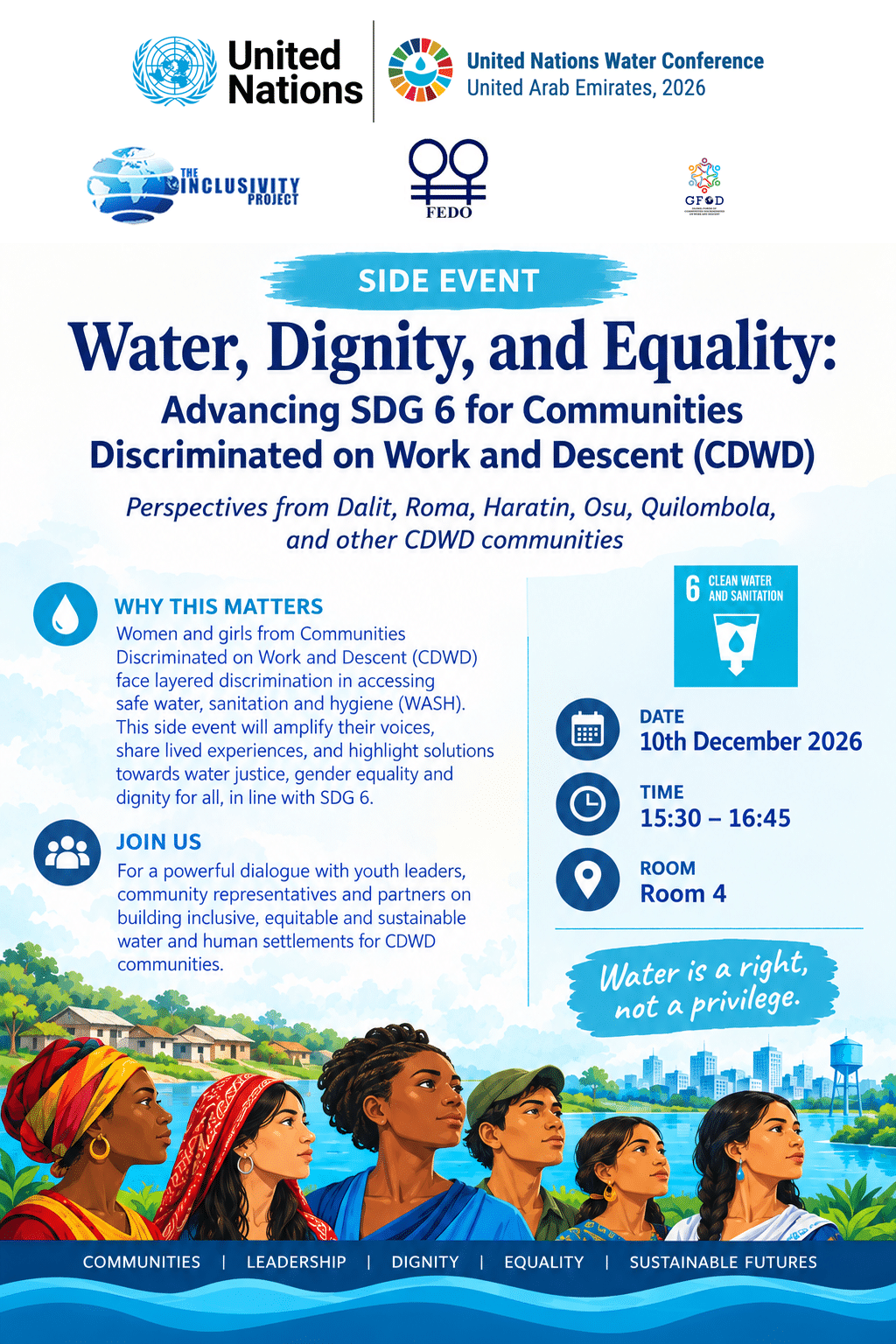
Side Event Jointly Organized by The Inclusivity Project (TIP) and Feminist Dalit Organisation (FEDO Nepal)
2026 UN Water Conference – Abu Dhabi, United Arab Emirates, 8–10 December 2026
Date: 10th December 2026, Time: 15:30–16:45, Room: 4
Co-organized by the Global Forum of Communities Discriminated on Work and Descent, Indigenous People Major Group, the Major Group of Children and Youth, and Together 2030; the International Water Management Institute
Registration Link: https://forms.gle/8Dda8XhG986ndPLx9
Background and Rationale
The 2026 UN Water Conference marks a critical moment to accelerate progress on SDG 6 in the final years to 2030. Despite global commitments, millions of people continue to face systemic barriers to safe, affordable, and stigma‑free access to water and sanitation. Among the most affected are Communities Discriminated on Work and Descent (CDWD)—including Dalits, Burakumin, Haratine, Quilombolas, and other groups across Africa, Asia, the Middle East, and Latin America.
Across regions, communities discriminated on the basis of work and descent continue to experience distinct and deeply entrenched barriers to accessing safe water and sanitation. Dalit women and girls communities in South Asia are often denied access to shared wells, water taps, and sanitation facilities because of caste-based notions of purity and pollution. Roma communities across Europe continue to experience spatial segregation and unequal access to water and sanitation services, with many families living in informal or segregated settlements where basic infrastructure is inadequate or absent. Burakumin communities in Japan continue to face the legacy of historical discrimination that has contributed to unequal opportunities and access to services. Haratine communities in Mauritania experience persistent inequalities linked to descent-based exclusion and poverty, while Quilombola communities in Brazil frequently struggle to secure safe water and sanitation due to insecure land tenure, geographic isolation, and inadequate public investment. Across these contexts, women and girls bear a disproportionate burden, travelling long distances to collect water, facing heightened risks to their health and safety, and carrying the primary responsibility to fulfil household water needs.
This side event aims to bring together governments, UN agencies, civil society, and CDWD and indigenous leaders to highlight the structural drivers of exclusion, share community‑generated evidence, and propose actionable pathways for integrating CDWD into global water governance, financing, and implementation.
Relevance to the 2026 UN Water Conference
This side event directly supports the Conference’s mandate to accelerate SDG 6, strengthen equity and inclusion, and build on the commitments of the 2023 UN Water Conference. By addressing one of the most persistent and least acknowledged forms of discrimination affecting water and sanitation access, the event contributes to a more credible, just, and effective global water agenda.
Proposed Speakers
Moderator: TBC
- CDWD Community Representatives-GFoD (women, youth, frontline sanitation workers)
- Indigenous leader- Co organisor/ United Nations Major Group for Children and Youth (UN ) representatives-Co Organisors
- IWMI- TBC
- FEDO Representative (including video) GFoD Leadership- TBC
- UN DESA / UN-Water Representative / UN Women -TBC
- Government Representatives from supporting Member States (e.g., Senegal, Nepal, Sierra Leone, Albania, Tonga, Botswana, Latin America, or Gulf States)- Letter to be drafted by Naveen for member states.
- SR on Water and Sanitation- TBC
- Civil Society Partners (Indigenous Peoples, disability networks, gender equality coalitions)