

- This event has passed.
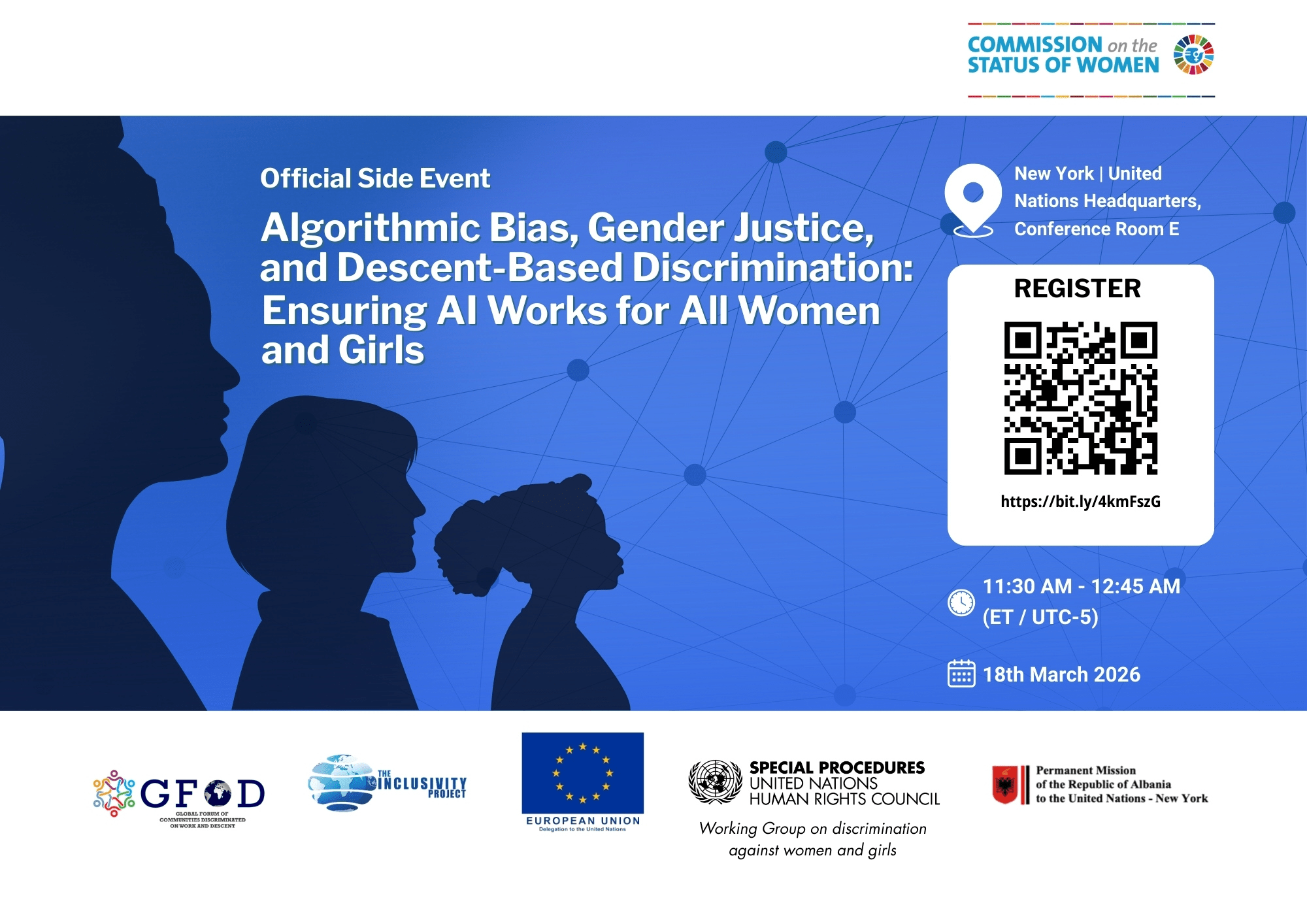
Algorithmic Bias, Gender Justice, and Descent-Based Discrimination: Ensuring AI Works for All Women and Girls
March 18 @ 11:30 am - 12:45 pm UTC-5
Gender discrimination remains deeply rooted in many societies and is often experienced through intersectional forms of inequality shaped by factors such as descent, race, ethnicity, socio-economic status, and digital access. As artificial intelligence becomes increasingly embedded across sectors, these intersecting inequalities risk being replicated and amplified through algorithmic systems.
Tools like risk prediction algorithms, forecasting-based law enforcement, automated welfare allocation, and online judicial processing are transforming decisions on entitlements, aid delivery, and legal remedies. Without global guidelines, openness, redress mechanisms, or
rights protections, these technologies frequently amplify entrenched gender disparities, embedding biases from past records, enforcement histories, and bureaucratic routines.
For women and girls from communities discriminated against on work and descent (CDWD)—including Dalit, Roma, Quilombola, Haratine, Burakumin, and other similarly affected groups—the risks are particularly severe. These communities already experience structural discrimination, over-policing, exclusion from services, biased judicial treatment, and chronic under-reporting of violence. When AI models are trained on biased data reflecting caste-, ethnicity-, or descent-based prejudices, the resulting systems risk:
- Disproportionately flagging CDWD youth as “high-risk”
- Intensifying surveillance of CDWD neighbourhoods
- Automating exclusion from welfare or social-protection schemes
- Misclassifying or deprioritizing CDWD women’s cases of violence
- Reinforcing discriminatory employment and labour-market barriers
This session delves into AI’s influence on women’s and girls’ pathways to justice, emphasizing compounded vulnerabilities from overlapping discriminations. It will also provide a timely platform for discussion ahead of the Working Group’s forthcoming thematic report to be presented to the Human Rights Council in June 2026.
Objectives
- Analyse how current uses of AI in governance, justice systems, and policing
reproduce gender, caste, ethnicity, and descent-based inequalities. - Highlight lived experiences of women and girls from CDWD communities regarding
AI-driven exclusion, surveillance, and barriers to justice. - Discuss safeguards and regulatory frameworks needed to ensure AI
strengthens—rather than undermines—women’s access to justice and protection
from violence. - Examine opportunities for AI to expand legal empowerment and support for survivors
when human-rights-based digital governance is applied.
To join this event please register here.
Partners
Permanent Mission of Albania to the UN New York
UN Working Group on Discrimination Against Women and Girls (WGDAWG)
The Global Forum of Communities Discriminated on Work and Descent (GFoD)
The Inclusivity Project (TIP)
European Union Delegation to the United Nations in New York