
Rights Experts reflections from the NGO Forum at the African Commission on Human and Peoples’ Rights in Dakar
By Uzumma Kathy Oyenucheya & Cira Harouna N'dongo
In October, our GFoD Rights Experts, Uzumma from the Osu community in Nigeria and Cira from the Haratine community in Mauritania, participated in the NGO Forum ahead of the 89th Ordinary Session of the African Commission on Human and Peoples' Rights (ACHPR), held in Dakar, Senegal. Their participation provided an opportunity to strengthen the visibility of Communities Discriminated on Work and Descent (CDWD) and advance advocacy for the recognition and protection of their human rights across the African continent.
“It was one of the most inspiring and humbling experiences of my career, and I'm still reflecting on it” says Uzumma.
“Our participation marked a significant and pivotal moment in our advocacy work. As a human rights defender, this continental platform provided me with an essential opportunity to amplify the voices of communities discriminated against on the basis of work and descent (CDWD) and to highlight the realities they face” says Cira.
Why this conversation matters
The African Union has declared 2026 the year of “Assuring Sustainable Water Availability and Safe Sanitation Systems to Achieve the Goals of Agenda 2063.” It is a timely theme. Across the continent, millions still lack safe drinking water and basic sanitation, and the burden does not fall equally.
Our panel focused on Communities Discriminated on Work and Descent (CDWD): people excluded because of caste-like, occupational, or descent-based status. For these communities, the water crisis is not only about infrastructure. It is about who is allowed to draw water from a shared source, who is left out of decisions on sanitation, and whose dignity is treated as negotiable (see Water Justice for All: GFoD Calls for an End to Work and Descent Based Exclusion at the 2026 UN Water Conference – Global Forum of Communities Discriminated on Work and Descent – GFoD ).
On the panel
Sharing the stage with organizations of co-panellists was a real highlight. We explored how structural exclusion shapes access to water and sanitation, and what governments and the African Commission can do about it.
“One moment stays with me,” says Uzumma. “Someone spoke about a politician living with albinism who was discriminated against in his own country and was ultimately killed. I was deeply shaken. It was a painful reminder that exclusion based on who a person is does not stay in the realm of attitudes. What struck me most was how consistent these experiences are across different countries.”
For Cira, one of the highlights of her participation was the solemn reading of the official statement on behalf of CDWD communities “Speaking before civil society actors, delegates, and institutional decision-makers was a powerful act of affirmation.It was an opportunity to present the communities' demands with clarity and conviction, highlighting the urgent need to address these forms of discrimination systematically in regional policies ” she added.
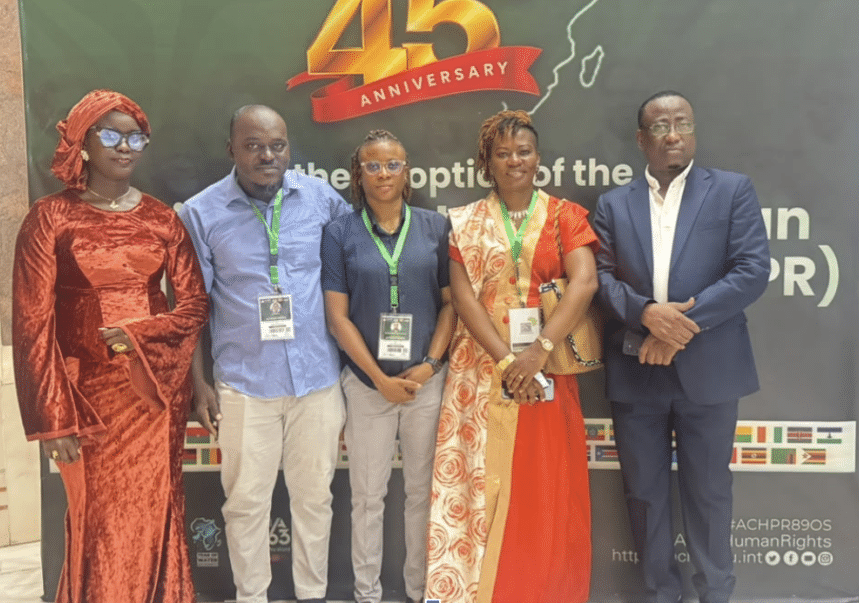
Photo from left to right: Cira Ndongo, Ali Camara, Uzumma Onyenucheya, Queen Bisseng, Chieck Sidati Hamady
Why Dakar, and why now?
Having this conversation in the lead-up to the ACHPR session mattered. The Commission's Resolution 619 (LXXXI) 2024 on the rights of CDWD gives us a strong normative foundation. The task now is to turn that commitment into practice so water and sanitation policies leave no community behind. That is also the promise of Agenda 2063's vision of a prosperous Africa built on inclusive growth and sustainable development.
This in-depth engagement with Africa's human rights protection mechanisms enriched Cira and Uzumma's professional journeys in several ways:
Firmly placing CDWD issues on the agenda of strategic discussions at the NGO Forum and the Commission.
Gaining a deeper understanding of the avenues for influence at the continental level, enabling us to better align our grassroots initiatives with international standards and requirements.
Building strong relationships with fellow African human rights defenders and coalition partners to unite our efforts in defending human dignity and fundamental rights.
“I leave this experience more determined than ever, with stronger advocacy strategies and renewed commitment to advancing the rights of marginalized communities and ensuring that the voices of the most vulnerable are heard” says Cira.
What's next
Our recommendations call for:
Recognizing CDWD explicitly in national water and sanitation strategies
Collecting disaggregated data to make exclusion visible
Ensuring CDWD communities take part in decisions that affect their access to services
Our sincere thanks to the organizers of the NGO Forum, my fellow panellists, and everyone who joined the conversation.We left Dakar energized and committed to following up. Clean water and safe sanitation are not favours. They are rights, and they belong to everyone.